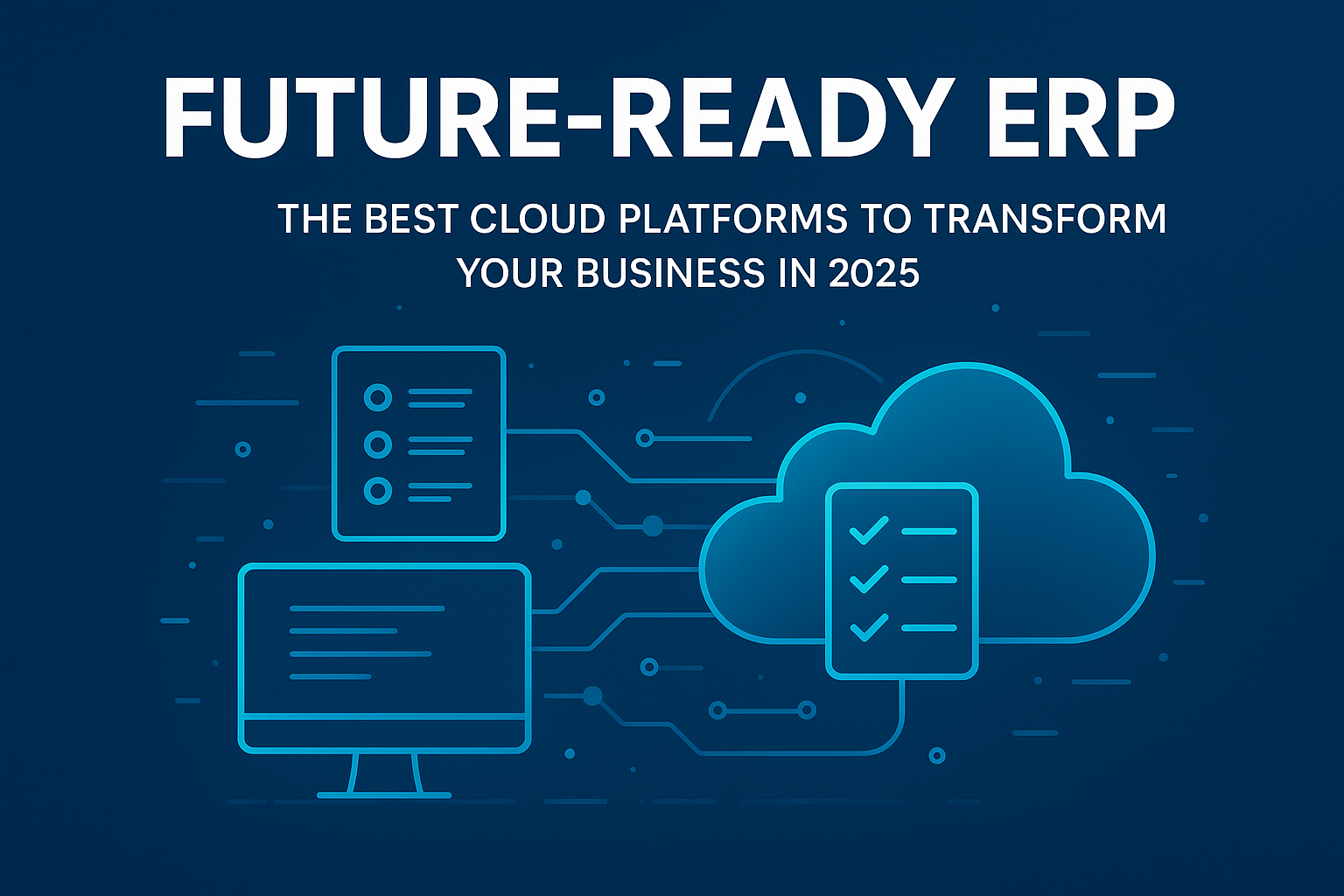
In today’s fast-moving digital economy, businesses must constantly evolve to stay competitive. One of the most transformative tools driving this change is Cloud ERP (Enterprise Resource Planning). Unlike traditional on-premises systems, cloud ERP platforms offer agility, scalability, and automation that help companies manage operations with precision. As we enter 2025, organizations of all sizes—from startups to multinational enterprises—are rethinking their technology stack. With AI-driven automation, real-time analytics, and mobile-first ERP solutions, cloud-based ERP has become the backbone of digital transformation. This guide explores the best future-ready cloud ERP platforms in 2025 and what makes them essential for business success.
Why Cloud ERP is Critical in 2025
Cloud ERP has become non-negotiable due to its ability to address modern business challenges. Here’s why it’s critical:
- Scalability on Demand: Cloud ERP grows with your business without the heavy upfront costs of on-premises infrastructure.
- AI & Automation: Automating financial workflows, supply chain management, and HR reduces errors and boosts productivity.
- Global Accessibility: Teams can collaborate seamlessly from anywhere, with secure access to real-time business data.
- Cost Efficiency: Pay-as-you-go subscription models lower IT costs while providing enterprise-grade capabilities.
- Digital Transformation Catalyst: Cloud ERP integrates with CRM, eCommerce, AI, and IoT tools, enabling businesses to operate smarter.
Keyword Focus: Cloud ERP benefits, digital transformation ERP
Top Cloud ERP Platforms of 2025
Here are the leading ERP software providers in 2025, each offering unique features for businesses at different stages of growth. This selection is based on industry insights, user reviews, and technological advancements.
| Rank | ERP Platform | Best For | Key Features | Pricing (Approx.) |
|---|---|---|---|---|
| 1 | Microsoft Dynamics 365 Business Central & Finance | SMBs to enterprises leveraging Microsoft’s ecosystem | Integration with Microsoft 365, Power BI, Teams; AI-powered financial insights; industry-specific modules | $70–$210/user/month |
| 2 | Oracle NetSuite | Growing mid-market and global companies | Multi-currency management, inventory, eCommerce, CRM integration; AI-driven dashboards | $99/user/month + base subscription |
| 3 | SAP S/4HANA Cloud | Large enterprises seeking AI-driven automation | Real-time analytics via HANA database, global compliance, supply chain, ESG reporting | $150+/user/month |
| 4 | Infor CloudSuite | Industry-focused (manufacturing, healthcare, logistics) | Vertical-specific templates, machine learning, mobile accessibility | Varies by industry & modules |
| 5 | Acumatica Cloud ERP | SMEs needing flexible pricing | Modular design, financials, CRM, project management; resource-based pricing | Usage-based, contact vendor |
| 6 | Epicor Kinetic (Cloud ERP) | Manufacturing and supply chain industries | Shop-floor automation, IoT integration, real-time production management | Contact vendor |
| 7 | Sage Intacct | Finance-focused and multi-entity enterprises | Advanced financial reporting, Salesforce integration, automated accounts payable | $400+/month base + user fees |
| 8 | Workday ERP | Enterprises prioritizing HR and financial planning | AI-powered workforce analytics, payroll automation, financial modeling | Contact vendor |
| 9 | Odoo Cloud ERP | Startups and cost-conscious SMEs | Open-source, modular apps for CRM, HR, inventory, eCommerce | $24/user/month |
| 10 | Syspro Cloud ERP | Distributors and manufacturers | Inventory management, logistics, IoT integration, real-time analytics | Contact vendor |
Key Trends Defining ERP in 2025
To make an informed decision, understanding the emerging ERP software trends is essential:
- AI & Predictive Analytics: Future-ready ERP leverages AI to forecast sales, optimize supply chains, and automate repetitive tasks.
- Industry-Specific Cloud ERP: Pre-configured templates accelerate deployment in verticals like healthcare, retail, and logistics.
- SaaS & Subscription Pricing: Affordable and predictable costs make ERP accessible to SMEs.
- IoT & ERP Integration: Connected devices feeding data into ERP improve real-time decision-making.
- Mobile & Remote Access: Cloud-native ERP ensures teams can work anytime, anywhere.
- Sustainability & ESG Reporting: More ERP providers include compliance and sustainability metrics for enterprises.
How to Choose the Right ERP for Your Business
When selecting a cloud ERP, consider these factors:
- Business Size:
- Startups/SMBs: Odoo, Acumatica, Microsoft Business Central.
- Mid-market: NetSuite, Sage Intacct.
- Large Enterprises: SAP S/4HANA, Workday, Infor.
- Industry Needs:
- Manufacturing: Epicor, Syspro, Infor.
- Finance: Sage Intacct, Workday.
- Services: Acumatica, NetSuite.
- Budget:
- Low-cost entry: Odoo ERP.
- Usage-based flexibility: Acumatica.
- Enterprise-grade: SAP, Workday.
- Ecosystem Compatibility: If your business relies heavily on Microsoft, Salesforce, or Oracle tools, choose an ERP that integrates seamlessly.
- Future-Proofing: Opt for platforms investing in AI, automation, mobile-first design, and ESG compliance.
Final Thoughts
Cloud ERP is no longer a luxury—it’s the backbone of digital transformation in 2025. The right ERP platform can streamline operations, reduce costs, and provide insights that drive growth. For SMBs, Odoo and Acumatica offer cost-effective flexibility. For scaling companies, NetSuite and Dynamics 365 deliver growth-ready tools. For large enterprises, SAP, Infor, and Workday provide robust global capabilities. For specialized industries, Epicor, Syspro, and Sage Intacct provide targeted solutions. By aligning your ERP choice with your company’s size, industry, and digital transformation goals, you’ll position your business for sustainable growth in 2025 and beyond.